On the Line – Demerara Tobacco Company Limited: Annual Report 2012

Introduction
The Demerara Tobacco Company Limited (Demtoco), held its Annual General Meeting this past Tuesday April 2, 2013, kicking off the season of annual general meetings of Guyana’s public companies with a December 31 year end. All public companies are of course regulated under the Securities Industry Act and the Companies Act. And, too, they all fall to be taxed under the various tax laws of Guyana. Or do they?

70% of Demtoco’s shares are held by British American Tobacco International Holdings (UK) Limited which in turn is a wholly-owned subsidiary of British American Tobacco plc. (BAT), also of the UK. Cheddi Jagan, no slouch for an economist, used to love measuring the power of the international companies by comparing them with the size of Third World countries’ economies. He would have hated Guyana’s economy’s relative size compared with BAT whose turnover across the world is six times the GDP of Guyana.

Continue reading “On the Line – Demerara Tobacco Company Limited: Annual Report 2012”

Not a watershed budget for the poorer person

As Guyanese analyse the Budget for 2013 it is useful to compare some of the numbers with how they are presented and received. There is no group which has welcomed the Budget more than the Private Sector Commission, one representative describing it as our (PSC) budget.

Let us take the apparently straightforward example of the reduction in the rate of personal income tax from 33⅓% to 30%. Readers will note that not only do individuals not have the benefit like dependents allowances while companies are allowed to deduct almost all their expenses, but the individual is still paying the same or higher rate of tax than non-commercial companies do, that is 30%.

If we exclude the personal allowance of $50,000 per month an individual’s nominal and actual tax rate is the same: 30%. Compare this with say GBTI whose nominal corporate tax rate is 40% but which enjoys a host of tax shelters. Its effective corporate tax rate for 2011 is 26.82%. Shareholders of GBTI pay no tax on dividends while its employees pay 30%. Even if we say that the company and the shareholder are the same – which it clearly is not – the shareholders’ tax rate is 26.82%. That is inequitable.

But let us get back to the benefits of the reduction in the rate of income tax and the increase in the rate of NIS, both of which impact on take home pay, or as the PSC says, spending power. In dollar terms, for each $10,000 earned by the worker the tax saving is $333. It means this: the worker who was earning $50,000 per month at December 31, 2012 gets nothing out of the budget; one who earned $60,000 per month takes home $333; one who earned $80,000 takes home $680 more, etc. The earliest point at which the increased take home pay exceeds $10,000 per month is for employees earning $380,000.

Note that I have not taken the projected inflation of 3.5% for 2013 into account. If that is done the income level at which there will be a net saving is for employees earning $296,000 per month. All persons earning below that income per month will actually be worse off.

The PSC is right: this is a watershed budget – but not for the poorer person.

Keeping it in the Family

Introduction
For decades, perhaps in some cases even close to a century, family businesses have formed the backbone of the Guyana economy. Some of these, like Psaila Bros., Rodrigues Limited, the Wright Brothers (Russian Bear) Bettencourts, Elias and Sons, D. M. Fernandes Ltd., R. B. Gajraj and Sons Limited, Jaikaran’s Drug Store, may have faded out of national memory. Some are in transition such as A. Mazaharally & Sons Ltd., A. Amerally and Sons Ltd., Toolsie Persaud Limited., A.H. & L. Kissoon Ltd. and Rahaman Soda Factory Ltd. We recall too the name B. & J. Khan and Daughters suggesting no sons.

Then there are a few family businesses which have survived but are not particularly active such as C.R. Jacobs and Ltd. and Central Garage Ltd. Of the still surviving and active family businesses John Fernandes Limited is perhaps the most successful, and prominent, growing into, by acquisition and organic growth into a conglomerate although A. Gafoor & Sons Limited has grown into a huge operation in its chosen line of business. And let us remember too that Banks DIH Ltd started as D’Aguiar Bros Limited and that Bookers itself that once was the B in British Guiana was once Booker Bros.

Why some of those family businesses succeeded while others failed requires much more than a newspaper column and would make an interesting study for the resourceful student of the University of Guyana. Indeed, such a study would make for a good book.

Continue reading “Keeping it in the Family”

Budget 2013 – Get ready to rumble

Introduction
I take these words not from Dr. Roger Luncheon who used it around the time of the Agricola protests but from the American boxing announcer who trademarked it. There are eight working days to go to the constitutional deadline of “before or within ninety days after the commencement of the year” for the presentation of the national budget. With the practice being a prior announcement and none having yet been done, tomorrow Monday can be ruled out. That leaves seven days. The practice too has been to present the budget on a Monday or a Friday. That leaves Friday 22 and Monday 25 since Friday 29 is another public holiday. And here is where it gets a tad tricky: of the six budgets presented by Dr. Ashni Singh as Minister of Finance, three were presented on a Monday and three on a Friday. So take your pick.

My bet is that B-day will be Monday 25 to allow the government’s propaganda machinery to move into high gear, with Shadow Finance Minister Carl Greenidge being the prime target. Some of the propaganda was on display a couple nights ago on Jagdeo’s surrogate television station whose owner and friend Dr. Bobby Ramroop was granted practically universal coverage to broadcast television and or radio in Guyana in a move in what many hoped were the dying days of the Jagdeo presidency.

“Cynical”, “crude”, “vulgar”, “obscene” are too mild terms to describe Jagdeo’s action in a demonstration of abuse of office that required only a perverse mind to conceive. If there is one single incident of dozens that make it vital that the Constitution be amended to rid Guyana of the curse of the executive presidency, then Jagdeo’s action on sharing out the airwaves mainly to his friends and party supporters must surely be the straw. But back to the budget.

Missed opportunities
The 2012 budget was historic not only for its size. The stage for the battle over the 2012 budget was set on November 28, 2011 when the voters of the country placed control of the National Assembly in the hands of the opposition. This was too much for the PPP/C which had become accustomed to ruling, bullying, buying, penalizing, harassing and intimidating those not prepared to tow its line. Once again there was not even a charade of consultation envisaged in the directive principles as well as the fundamental rights enshrined in the Guyana constitution. With the wind in its sail, it was a chance for a united, reinvigorated opposition to assert its authority over public expenditure in Guyana.

On the last day permitted under the Constitution, the Minister of Finance presented his 2012 Budget with the theme “Remaining on Course, United in Purpose, Prosperity for All”, calling for expenditure of $193Bn, or 25% above 2011 spending. The budget included the sum of $4Bn for GuySuCo and $6Bn for Guyana Power & Light Inc., both state entities. While the opposition seemed to have had some idea of what it wanted, the leadership appeared confused on a clear and united strategy to challenge the Budget. After some initial differences between the AFC and the APNU whose leadership appeared to have sided with the Government on the contentious issue of the electricity tariffs in Linden, the parliamentary opposition settled down to addressing the expenditure side of the budget. Of course those initial differences caused a number of missed opportunities for stamping fiscal discipline on the entire project and process.

Cut
The Estimates of the Public Sector for the year 2012 were tabled as Bill No. 3 of 2012: Appropriation Bill 2012 with current and capital expenditure totaling $103.9Bn and $75.8Bn respectively. Of the dozens of budget agencies including known abusers of the public purse, only four were subject to any cuts, among which was GECOM for which the expenditure proposal was clearly excessive. And the real significant cut was to the budget of the Ministry of Finance in respect of expenditure out of LCDS funds which the Minister projected would be received. In many ways therefore the cuts were more symbolic than real. Principally they targeted NCN and the Office of the President where PPP/C politicians, long past their sell-by dates were put on the payroll to be paid by taxpayers, often at higher salaries and the same perks they previously enjoyed.

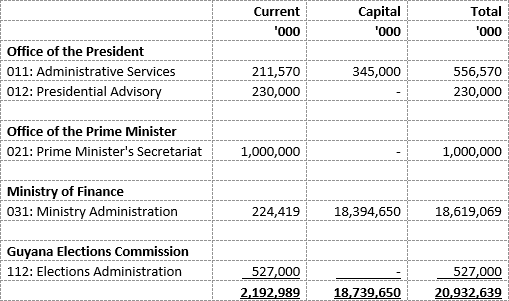
The cuts were reflected in Act No. 3 of 2012: Appropriation Act 2012 which was passed by the National Assembly on 26 April 2012 with current and capital expenditure totaling $101.7Bn and $57.0Bn respectively after cuts in five account lines:

2013.03.17_Table1

Enter the courts
However, after the revised budget was approved without dissent by the entire National Assembly the Attorney General Anil Nandlall in his wisdom advised the Government to go to the court and challenge the power of the parliament – including the President – to cut the budget. The AG went to the courts for several orders for the restoration of the amounts cuts by the National Assembly, all of which were refused, except for the sum of $99,000,000 for the Ethnic Relations Commission (ERC). The reason for restoring the amount for the ERC was that the ERC is a constitutional body subject to a direct charge on the Consolidated Fund. Accordingly, its budget allocation was not subject to a vote of the National Assembly.

For the other heads, the Chief Justice (ag) rejected the application of the Attorney General and denied the Minister of Finance the “liberty” to make advances/withdrawals from the Consolidated Fund to restore the $21 billion 2012 budget cuts. Opportunistically the government chose to misrepresent and possibly violate the ruling by the Chief Justice which was described in his written decision as being in its “preliminary stage” and that “the views expressed at this juncture are not final.” Unfortunately the lawyers for the Speaker Mr. Raphael Trotman and Mr. David Granger, the Leader of the Opposition who along with Dr. Ashni Singh were the defendants in the matter never pursued the case to finality. Mr. Nandlall and Drs. Singh and Luncheon did not allow this simple fact to get in the way of their story that the cuts were unconstitutional. There was simply no ruling except in respect of the ERC. I have no doubt that we will see a reprise of the battle over the 2013 budget.

Dr. Singh v Greenidge
But there is a larger and more practical point. From the following exchange between the Minister of Finance and his counterpart on the opposition benches, it appears that consistent with their belief, contrived or otherwise, the government found ways to restore the cuts as necessary, some by way of the parliamentary route and others from sources unknown. After all the government has so many public funds around the place which are subject to no oversight, that finding money is not a problem. Apart from what are in effect slush funds there is always NICIL and the GGMC to help when called upon.

Here is that exchange between Mr. Greenidge and Dr. Singh:

TENTH PARLIAMENT OF GUYANA – FIRST SESSION (2012)
NATIONAL ASSEMBLY – NOTICE PAPER No. 115 – Q. 66 Opp. 65

RESTORATION OF THE SUMS DELETED FROM 2012 BUDGET

QUESTION by Mr. Carl Greenidge, M.P.

Would the Hon. Minister of Finance say whether monies cut from the Budget and not approval (sic) by this House have been restored to the Ministries? If so,

What categories and sums have been involved?

What is the legal basis for such payments?

What advice was provided on this matter by the Attorney General?

What section of the Chief Justice’s report/decision suggests that either the Chief Justice or the Ministry of Finance can restore cuts to the budget or that the Chief Justice can authorize the Ministry of Finance to make advances from the Consolidated Fund?

ANSWER – The Minister of Finance

Where the sums approved by the National Assembly under the Appropriation Act 2012 were found to be inadequate to meet the services of Government, supplementary financing was resorted to in accordance with the law.

The categories and sums involved have already been reported to the National Assembly in successive Financial Papers.

The Constitution and the Fiscal Management and Accountability Act 2003.

The Attorney General confirmed in advance the appropriateness of the course of action adopted, which course of action was also approved by the Cabinet.

The Chief Justice made several relevant references to the Constitution.

Conclusion
There have been no substantial consultations on the 2013 budget nor have the political parties drawn any lines in the sand. Guyana is hardly any better off now than one year ago. Surely the budget is the occasion to get agreement on some vital requirements for governance. There should be no delay in appointing the Public Procurement Commission; in appointing and Ombudsman; in appointing a Chancellor and a Chief Justice; in establishing the Integrity Commission; in introducing anti-corruption legislation; in bringing the Judicial Review Act and the Access to Information Act into into effect; in reforming NCN and the Chronicle; holding local government elections; dealing with tax reform; and in activating the Constitutional Reform Commission.

The Budget cannot be divorced from these important elements in how the country is managed. Let us fix them now.

Soul for sale: The Marriott saga conclusion

Introduction
Well, Mr Brassington has done it again. Like he did to me over the Berbice River Bridge Company, he wanted me to hold back a column while he committed NIS money to the Berbice Bridge. On this occasion he needed a weekend to respond to my questions on his Marriott. Well it turned out that ten days were not enough to provide answers to what I thought were straightforward questions. Maybe he was too busy.

I am sorry if I piqued readers’ interest or led them to believe that the public will receive first hand, honest-to-goodness truth to questions we are all dying to have answered. I apologise to you all for leaving you without any answers to a string of questions which I have put to Mr Brassington. It was his undertaking that made me not divulge the questions last week.

But if there does come a time when Guyanese officials are made accountable for their abuse of office, when they can no longer make promises which they have no intention of honouring and when they will have to deal with public money in a lawful and transparent manner, Winston Brassington will surely be listed among the pantheon. For him, the indictment will be long and damning: complicity and execution of NICIL’s illegalities; the Amaila Road contract to ‘Fip’ Motilall; the privatisation of the Sanata Complex and the illegal concessions to Queens Atlantic Investment Inc; his hinterland road-building exercises with GGMC billions; his shenanigans with fund-raising for the Berbice River Bridge Company Inc; and now the Atlantic Hotel Inc of which he remains the sole director, Chairman and CEO.

Expertise or conviction?
I had understood from someone in the engineering fraternity that there were concerns including a criminal conviction of one of the persons reportedly involved in the supervision of the construction of the hotel. So I asked for the name, expertise and experience of the firm or individuals looking after AHI’s interest in the construction of the building; if it was an individual, the person’s qualifications and experience in projects of this magnitude; whether the position was advertised and who was responsible for the selection; who the person reports to and whether that person was provided with all the documentation, specifications and drawings for the foundation, plumbing, electrical, concrete pours, curing period for different aspects of the concrete work, steel size and resistance capacity, etc; and I asked about the number of non-compliance reports submitted to date by AHI’s representative.

On the contractual deals with Marriott International I sought from Mr Brassington information on the precise role of Marriott International in the design and construction stages of the contract; the basis and the amounts payable and paid to Marriott for the two phases; whether withholding taxes were deducted from those payments and remitted to the Guyana Revenue Authority; and whether the contract for the management of the hotel has been signed and sealed. I also subsequently asked for copies of the contracts with the Marriott.

The mysterious private sector partner
The project has always been promoted as a public-private sector partnership with the Grenada- based Zublin identified as the/a partner. Of course, the term private-public sector partnership can mean whatever one wants it to mean. To clarify the point and satisfy concerns expressed by cynics that Zublin was never seriously involved and was merely a red herring, I asked Mr Brassington whether the discussions/negotiations with Zublin had been concluded and for him to confirm the percentage of the shareholding Zublin would take and the price for each share issued.

After all the hotel would be worth much more than the actual amounts paid to the contractor. If we divert for a moment and look at the financial statements of Atlantic Hotel Inc as at December 31, 2011 we see the flawed accounts signed by Mr Brassington and given a clean audit opinion by the Audit Office. Only the Guyana dollar equivalent of the payment to the contractor has been recorded in the accounts. It is a matter of public knowledge that NICIL has spent not inconsiderable sums in infrastructural works; it must also have paid Marriott several millions for services provided while it is reported that a huge sum has already been paid to the engineers looking after the country’s interest. None of these costs are reflected in the books of AHI and must have been paid by NICIL, which engages in so many disparate activities that it can be confident that the Audit Office would be unable or uninterested in identifying those costs which are properly chargeable to the hotel company.

And surely those concessions which Mr Brassington has negotiated from Go-Invest have a huge value which must be factored in any price. The selling price of the shares in the hotel should therefore exceed the actual cost giving rise to a huge profit. Of course, Director Brassington will argue, quite incorrectly, that the profit belongs to the company and can only be distributed by way of dividends.

To return to the identity of the buyer which Dr Luncheon has indicated has already been agreed, I asked Mr Brassington about the alternative arrangements that AHI/NICIL have put in place in case Zublin is no longer interested. Some people think that the name Atlantic is more than a coincidence since there is another beneficiary of state largesse with Atlantic in its name. Or is it a ‘brother’, peeved that he was forced out of the business the first time around?

SCG
The public will recall that Mr Brassington had said that the contractor SCG International (Trinidad and Tobago) Limited (SCG) had insisted on the exclusion of Guyanese from its labour force, apparently because we are not up to their standard. But my failure to see such a clause and my prior experience with Mr Brassington compelled me to ask him a direct question: where in the contract does it state that the labour force is Chinese only? To put it politely, he did not tell the truth.

Readers will recall that I reported in an earlier column that an official search I had carried out at the Companies Registry came up with the astounding fact that SCG was not legally permitted to carry on business in Guyana. So I asked Mr Brassington whether he or his legal secretary had checked to see whether SCG is incorporated or registered in Guyana before entering into a multi-billion dollar contract with them. It was almost laughable that following the column frantic but improper efforts were made to register the company with the Registrar.

At large is whether the company has registered with and is complying with the income tax and NIS laws of Guyana. The laws of Guyana treat such omissions as extremely serious and one can be sure that the GRA could step in with heavy boots when it finds out. That is surely how SCG should have been treated.

One of the requirements for registration with both these bodies is that the company be registered or incorporated in Guyana. Since it has not been registered, it is a fair assumption that the previous suggestion that the company is excluded, or has excluded itself from the tax and NIS laws of Guyana is more than justified.

Readers will recall that SCG, in bringing down their tender price from US$65 million to US$51 million, had indicated that it would exclude a number of works and the critical certification of which the government boasts. I have asked for the estimated cost of the several other elements of the project which SCG excluded, whether funding for those works and the balance of the contract price had been sourced.

Conclusion
Mr Brassington has chosen to ignore direct questions from a taxpayer and citizen of this country. He is shielded by equally opaque politicians who could not be bothered about answering questions from anyone. Democracy and accountability have been turned on their heads, or dumped into the Atlantic next to the hotel.

There is nothing more that civil society can do. All the questions have been asked while any answers have been provided by the media itself. It is the new democracy, the new dispensation. There is no room for questions.

To summarise, the government has embarked on the conception, construction and financing of a $10 billion hotel built with taxpayers money but from which taxpayers labour was explicitly excluded in a collusion between the Government of Guyana and the Chinese construction company. The hotel will be sold to God knows who at a price which has not been determined. The hotel comes with concessions extending in some cases to twenty years – itself historic.

Meanwhile we claim that we cannot afford to increase the subvention to the University of Guyana, equip our regional hospitals and health centres, pay better pensions or solve the problems at the NIS.

It is a new model of development.