Bridging Deed sells both patrimony and soul (3rd. Instalment)

This Published on February 6, 2021

Two days ago, Column 84 set out the main provisions of the 2016 Bridging Deed. That Deed purported to keep alive the 1999 Petroleum Agreement signed by then President Janet Jagan. Effectively, it not only allows the three oil companies all the benefits under the 1999 Agreement, including precontract costs, and for the Government to pay their taxes in Guyana, but for those and enhanced benefits to run unchanged to 2056. No Parliament until then will have the power to make any law adverse to the interest of the oil companies, without compensating them. Nor can the Government stop paying their taxes to the GRA for them. It probably bears reminding that all three companies are incorporated in offshore tax havens and are merely registered in Guyana.

Two days ago, Column 84 set out the main provisions of the 2016 Bridging Deed. That Deed purported to keep alive the 1999 Petroleum Agreement signed by then President Janet Jagan. Effectively, it not only allows the three oil companies all the benefits under the 1999 Agreement, including pre-contract costs, and for the Government to pay their taxes in Guyana, but for those and enhanced benefits to run unchanged to 2056.

No Parliament until then will have the power to make any law adverse to the interest of the oil companies, without compensating them. Nor can the Government stop paying their taxes to the GRA for them. It probably bears reminding that all three companies are incorporated in offshore tax havens and are merely registered in Guyana.

As noted in Column 84, the Bridging Deed describes the Contract area for the 2016 Agreement as the Stabroek Block, “being the area covered by the 1999 Agreement”. Someone forgot to draw to Trotman’s attention that a new licence is expressly prohibited under section 22 (2) of the Act which states in mandatory language that “A petroleum prospecting licence shall not be granted to an applicant in respect of a block which is, at the time the application for the grant of the licence is made, comprised in a licence already granted.” It is clear then that no amount of legal gymnastics could circumvent this express provision prohibiting a second bite of the cherry.

The Government is in a catch 22 dilemma: if it argues, as it does in some places, that the 1999 Prospecting Licence had not expired at the time of the Application for the 2016 Licence, then section 22 (2) applies and there could be no second prospecting licence. And if it claims that the 1999 Stabroek Licence was expired, as Attachment “A” to the Bridging Deed indicates, it has two formidable hurdles. The first is that its purported Relinquishment is meaningless since under section 28 of the Act, relinquishment is only permissible “at any time when the licence is in force”. The second is that Attachment “A” to the Bridging Deed refers to the “expired Stabroek Licence Area”. That in my view makes the Deed ineffective since the 2016 Agreement could not be linked to a dead anything.

In his lame defence, Trotman embarrassingly argued that the Bridging Deed is like a savings clause, that it is quite normal. What Trotman does not seem to realise is that a savings provision has to be expressly permitted in legislation, or in some higher document, not in any agreement or instrument of lesser status.

Odd things happen

Here is another oddity: the Deed provided for the signing of the New Petroleum Agreement. The only trouble is that on the date of the Bridging Deed, the New Petroleum Agreement had already been signed and executed. Someone interfered with and initialled the date on the Deed but actually made it worse, and worse still, the change was not initialled by all the signatories to the Deed as is required.

A requirement set out in the Bridging Deed that the National Assembly approve an Order under s51 (1) of the Petroleum Exploration and Production Act, modifying certain specified tax laws to the Oil Companies, and the gazetting of the Order may not be so unusual, except that our sovereign body was expected to do so in within a time demanded by the oil companies. More importantly however, the Deed required the Minister of Finance to table a copy of the New Petroleum Agreement in the National Assembly when he brought the “tax modification” Order there. The Minister failed to comply. The inescapable inference is that he wanted to, and managed to hide the Agreement from the National Assembly and Guyanese until the Government was embarrassed into publishing it following the revelation of the Signing Bonus. Because the omission to table the Agreement did not prejudice the interest of oil companies, they too could not care less.

Looking after our interest

But the question must also be asked of the Escrow Agent Sir Shridath, a long-term consultant to the Government of Guyana: why did he not carry out his obligation to ensure that the conditions of the Bridging Deed were met by both sides? As a beneficiary of the public purse, did he not consider himself as having any obligation, fiduciary or otherwise, to the people of this country to see that undertakings made in their interest are honoured?

As a public official, the Minister is required to exercise discretion in making decisions. The Bridging Deed however took away much of his discretion under the law by setting out in advance what he would accept as Notices, and the text and extent of the Application for a Licence, including for the granting of a licence in respect of more than sixty blocks. By specific law, this has to be justified by special circumstances. Those who make Venezuela the bogeyman ignore the fact that many of the blocks awarded under the 1999 and 2016 Agreement are in undisputed waters and a significant number are much closer to Suriname than to Venezuela, and therefore raise no threat. And while the law allows the Minister a discretion in a section 51 tax exemption, the Bridging Deed made it into a condition.

Nothing however shows Exxon’s bad faith more than its announcement of a major find, one day after the Granger Government awarded them a tainted Petroleum Agreement made possible by the infamous Bridging Deed. It is either trickery or conspiracy. We Guyanese need to take our pick.

In concluding on the Deed tomorrow, the column will touch on some current developments.
Bridging Deed sells both patrimony and soul (2nd. Instalment)

This was Published on February 04, 2021

This Column regards the Bridging Deed conceived by some artful legal mind as going to the heart of the 2016 Petroleum Agreement – one of the first major economic acts of the Granger Administration. The handmaiden for the transaction was Mr. Raphael Trotman in his capacity as Minister of Natural Resources while its custodian or guarantor was Sir Shridath Ramphal. In an article in the Kaieteur News of February 1, 2018 seeking to justify the Administration’s refusal to make the Deed public, Trotman claimed that he needed to consult Sir Shridath Ramphal on the release of the document. He volunteered that there was nothing sinister about the Deed (with a capital “D”) and that Sir Shridath was selected as its guardian because the Government and Esso had confidence in him as a good person. In the subsequent two years, Trotman has been eloquently silent.
Column # 83 published last Friday revealed things about the Deed that challenge Trotman’s language. Because of my assessment of the Deed’s fundamental importance to the country, I sought and obtained the agreement of the senior editorial management of the Stabroek News to carry three columns this week – Tuesday, Thursday and the concluding piece on the usual Friday. This first part is
descriptive not judgmental, objective rather than subjective, narrative rather than critical. That was also the approach I took when in the earlier segments of this series of columns I dealt with the Agreement proper. Here are some of the key elements of the Deed. It was made on 29th. June 2016 and had four parties: the Government of Guyana and three oil companies – Esso Exploration and Production Guyana Limited (Esso), Hess Guyana Exploration Limited and CNOOC Nexen Petroleum Guyana Limited. They listed as their countries of incorporation The Bahamas (Esso), the Cayman Islands (Hess) and Barbados (CNOOC Nexen) and their registered office 62 Hadfield and Cross Streets, Georgetown, Guyana.

The Deed appoints as Escrow Agent Sir Shridath Ramphal of a Barbados address. It refers to an Escrow Letter dated the same date as the Deed sent from the Escrow Agent to the four Parties. The letter sets out the terms of the Escrow Arrangement whereby the Escrow Agent holds the Documents on behalf of the parties “subject to the satisfaction of certain conditions”. The terms “documents” and “Escrow Conditions” are defined only as having the meaning set out in the Escrow Letter.
The Deed is signed by Minister Raphael Trotman for the Government while the same persons who signed the 2016 Petroleum Agreement signed the Deed for the oil companies. There were two witnesses to each signature to the Deed while a single and
different person signed as witnessing the execution of the Petroleum Agreement. The Agreement was made on the 27th of June 2016 and the Deed was made on the 29th of June 2016.
In terms of contents, there is the Deed proper which runs to twelve pages. The Deed has the following attachments: Schedule 1 – Form of Notice of Intent to Relinquish; Schedule 2 – Form of Relinquishment Notice; Schedule 3 – Form of Regulation 28 Application; Schedule 4 – Section 51 (1) Modification (by Minister of Finance); Schedule 5 – Form of New Licence Application; Attachment “A” –Application for Petroleum Licence concerning the expired Stabroek Licence Area; and Part B – Form of section 14 (2) (a) Notice acceptance of conditions for the grant of a licence. Action/Decisions required under the Deed A – On the signing of the Deed Parties to procure that the Escrow Agent sign Escrow Letter and Parties to countersign the Escrow Letter. Parties to sign and deliver six copies of New Petroleum Agreement to the Escrow Agent for Registration at Deeds Registry. Minister was required to retain one of the Originals, a copy of which was to be provided to the National Assembly as part of the section 51 of the Petroleum Act with respect to taxation.
Oil companies to sign but leave undated two originals to the Relinquishment Notice and New Licence Application and deliver the signed originals to the Escrow Agent.
The Minister to sign and deliver to the Escrow Agent two undated originals of the section 14 (2) (a) Notice. Section 14 (1) deals with the notification of the granting of a licence while 14 (2) (a) deals with the acceptance of that licence; and within five business days from the date of the Deed Oil Companies to sign and deliver to the Minister a Notice of Intent to Relinquish with intended Relinquishment conditional on the following: The receipt of dispensation from Minister pursuant to Regulation 28 application. This regulation deals with modification of requirements in relation to the keeping of records, the surrender of records, and the maintenance of accounts.
The National Assembly to approve an Order under s51 (1) of the Petroleum Exploration and Production Act, modifying certain specified tax laws to the Oil Companies, and the gazetting of the Order. Esso on behalf of the Contractor Parties as well as the Minister to deliver Confirmation Notices pursuant to clause 4.2 of the Escrow Letter before the Escrow Termination Date. In the absence of the Escrow Letter it is not possible to ascertain other than by speculation what clause 4.2 is all about.
Following which the Minister to deliver to them, within thirty Business days, a confirmation note that Regulation 26 will be dispensed.
Before delivering the Confirmation Notice to the Escrow Agent, the Minister to give Oil Companies no less than five Business Days’ notice of his intention to do so.
Parties to coordinate with Escrow Agent to arrange a suitable Completion Date following satisfaction of the Escrow Conditions. The Deed defines the Completion Date to have the meaning given in the Escrow Letter. Column 85 to be published this coming Thursday will discuss some of the contents of the Deed.

COVID-19: An Overview and Lessons for Guyana

Dear Editor,

Guyana’s electoral fiasco may have overshadowed the other major crisis which it faces, the COVID – 19 pandemic. As of Saturday April 11, Guyana had carried out 193 COVID – 19 tests, of which 45 were positive, with six deaths. A review of the COVID – 19 data[1] for forty-five countries from across the world shows the USA, the wealthiest country in the world, having the highest number of deaths (21,409), with the fear that the peak may not yet have been reached. The USA also tops the chart for the greatest number of tests carried out by any single country.


USA/Europe

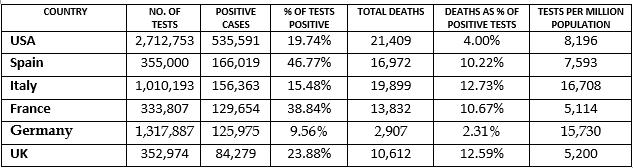
The next four countries in terms of deaths are Italy, Spain, France and the United Kingdom. In terms of tests carried out relative to population, Italy which has the second highest death rate has carried out the highest number of tests measured in relation to population, followed by Germany at 15,730 tests per million of population. Spain had the highest percentage of positive cases (46.77%) of number of tests carried out. Counterintuitively, Italy had the lowest percentage of positive cases to tests, confirming the widely held observation that the Italian cases were concentrated in particular areas. Italy and the UK had the highest percentage of deaths to tests carried out. The success story is arguably Germany which has about the same number of cases as France but did three times as many tests and suffered only one-fifth of the fatalities.

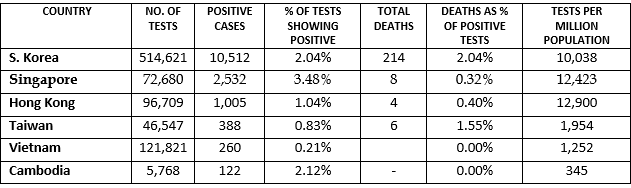
Here is what the Table shows for six countries in these geographical areas:   


South East Asia

Perhaps because of their proximity to China, the countries of South East Asia responded early and aggressively. Singapore, South Korea, Cambodia, Taiwan, Vietnam and Hong Kong appear to have managed the pandemic far better that the countries of Europe and the USA. South Korea is widely held up to be the gold standard for management of the virus with the highest number of tests overall. However, that number translates to 10,038 per million of population which is lower than Singapore and Hong Kong, both of which recorded less than half percent of deaths to number of positive cases. In fact, only South Korea had a relatively significant number of deaths (214) with Singapore, Hong Kong and Taiwan having 8, 6 and 4 deaths respectively with Vietnam and Cambodia reporting not a single death from the disease. Both these countries had considerably lower incidence of tests than the first category selected above with Cambodia being particularly low at 345 tests per million of population.  


Commentators from western countries were quick to point out that China where the virus started was able to manage the virus using measures that the west would find unacceptable. Of course, Singapore, South Korea, Hong Kong and Taiwan provide an instant rebuttal.


Africa

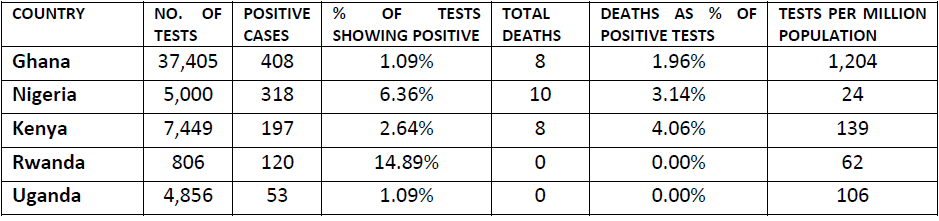
The countries of Africa have also performed well with very few deaths as the following table shows. Nigeria is a huge country with close to 200 million people spread over nearly one million km2. Ghana was the leader in number of tests, almost double the number done by Nigeria, Kenya, Rwanda and Uganda, the latter two recording no COVID – 19 death. Despite having one of the lowest test rates in the world – 24 out of every million – the percentage of those tested proving positive was in single digit at 6.36%.

Nigeria’s strong epidemic response infrastructure is in large part responsible for their relative success. The Nigerian Centre of Disease Control has been investigating pandemic preparedness for the last three years. At the time of the incident case, they had already established Public Health Emergency Operations Centres (PHEOCs) in 23 out of the 36 states in Nigeria for the purpose of detecting, preventing, monitoring, preventing epidemics. The country’s experience with Ebola also bolstered its response. The incidence case was detected within 48 hours of the person arriving in Nigeria.

Readers will recall that the region was ravaged in 2014 – 2016 by the dreaded Ebola virus disease (EVD) which like the corona virus traced its origin to wild animals. The fatality rate of the EVD reached 60%. The African countries took strong and effective public health measures in the aftermath of the EVD and the benefits may be paying off. Rwanda’s rate of positive test was 14.89% which is more consistent with the rate experienced in the European countries.     


South America

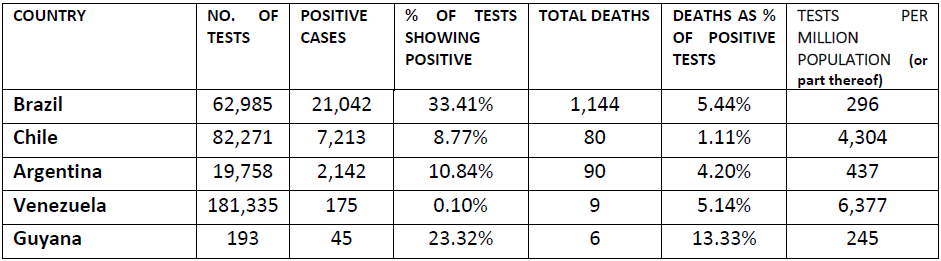
Brazil’s ultra-right wing President Bolsonaro is among the handful of world leaders still scoffing at the threat of coronavirus to public health. It is no surprise then that relative to population, Chile has tested fourteen times the number tested in Brazil. Troublingly for the people of the South American giant is that one in three persons tested came out positive and more than 5% resulted in death. Chile’s tests are also coming back with a fairly high positive rate and a 1.1% death rate.

The real exceptional case in South America is Venezuela which only last month was predicted in the western media, to become an epicentre of the virus. In fact, Venezuela has carried out one of the highest test rates per million of population (6,377), among South American and Caribbean countries. Only Chile (4,304) and Barbados (2,599) come anywhere close. For convenience I have placed Guyana among the South American countries as it shares land borders with Brazil and Venezuela.

Of the forty-five tests carried out by Guyana, 23.3% were positive and resulted in six deaths. Guyana has its own special problems having alienated itself with electoral shenanigans meaning that there is no legitimate Government, the President is in hibernation and the Minister of Public Health seeming to be out of her depth. Meanwhile, the outgoing Government’s application for modest assistance from the World Bank has been stuck in the system.    


The Caribbean

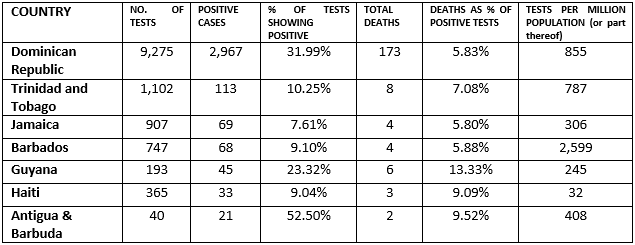
Comprising mainly island states, the six countries which include Guyana, are in lock down and are already facing serious fiscal and economic challenges, which are getting worse by the day. Tourism plays a significant role in the economies of all the OECS countries including Antigua and Barbuda, Barbados and to a lesser extent Jamaica, all countries included in the Table. Haiti, another such country, has suffered from one calamity after another over several years. COVID-19 could therefore only exacerbate an economy under severe stress.

Except for Barbados, significant testing does not appear to be part of the strategy of these countries of the Caribbean. Although it is possible that this is simply because of the unavailability of these tests either because of funding or the mentality that COVID – 19 was a “Chinese thing” that would not come to these shores. Deaths in all the countries remain in single digits with some of them resulting from imported cases, as is the case of Guyana where Patient Zero was a visiting American Guyanese.

Antigua & Barbuda stands out as the only country in the world that has had positive test result in excess of 50%. For its part, Guyana ranks highly in this metric at 23.32% and it is unclear why neither Antigua & Barbuda nor Guyana is not extending their test. This apparent reluctance only fuels speculation, especially in Guyana where statistics have been controlled by a very partisan politician.    


Lessons for Guyana

The statistics do not offer any clear direction for Guyana. South Korea is considered a gold standard in testing because it began widespread testing very early. Guyana did not do so and is now well past that stage. It is not clear how many test kits Guyana has and why these have not been used. The entire process is being controlled by a Minister better known for her partisanship than for her competence.

For all the conflicting directions in which the statistics point, there are a few ways in which COVID – 19 can be defeated. Social distancing, the wearing of masks, personal hygiene, including the proper washing of hands, contact tracing, the wide availability of tests and early results. Additionally, a challenge of this magnitude requires strong and informed leadership, teamwork, trust and resources. At the national level, Guyana has failed in almost every single matrix.

No one knows what resources are available, the national leadership is exclusive rather than inclusive, the President seems himself to be in lockdown, the Government is paralysed by its own making, there is no Parliament to make laws and most of the initiatives come from a disparate number of political and other groups. All of this in a country that is considered among the least prepared to deal with the virus.  

Meanwhile, major sections of the country are in lockdown or underperforming as a result of the combined effects of the unwillingness of the loser of the March 2 elections to concede defeat and a weak response to COVID – 19.

Except for non-essential services, the country’s economy is on lockdown until May 4th. Many businesses have sent home workers but with no assurance of payment. Some businesses will find it difficult to resume. In the country’s first year as an oil producing country, Government projected revenue will take a substantial hit, partly as a result of the sharp decline in oil price. There is no consensus of the elements of the decision to reopen the country’s border and its economy.  

When the lockdown is over, the electoral and constitutional mess will continue. 2020 will go down as one of the most difficult years in the history of the country.    

13 April 2020


[1] Source: https://www.worldometers.info/coronavirus

Address to the 6th triennial Conference of the Federation of Independent Trade Unions of Guyana (FITUG)

Chairman, Leaders of the Trades Union Movement, workers, officials, members of the media, ladies and gentlemen.

Thank you Mr. Chairman.

When I was invited by letter to deliver the feature address and declare open this 6th. triennial Conference of the Federation of Independent Trade Unions of Guyana (FITUG), I hesitated particularly as I looked at the calibre of my predecessors for the last three Conferences. In 2009, it was Senior Counsel Ashton Chase who is arguably the most knowledgeable person in Guyana in the law and practice of labour matters. He was followed in 2012 by Mr. Donald Ramotar, then President of Guyana and three years later by Dr. Nanda Gopaul who has had a proud and active association with the labour movement and more particularly with the National Association of Agricultural, Commercial and Industrial Employees of which he was once the General Secretary.

I accepted, so I must deliver, whatever my concerns, reservation and nervousness.

In this presentation, if you do not shout me down earlier, I want to deal with some of the troubling issues confronting the labour movement and the country. The order of topics is sugar, next I will speak briefly about oil and successive governments’ failure to protect the patrimony of the country and the interest of the people. I will then turn attention to the disunity and leadership crisis in the labour movement, government and labour, and threats to democracy. Continue reading “Address to the 6th triennial Conference of the Federation of Independent Trade Unions of Guyana (FITUG)”

Statement of ExxonMobil’s Signing Bonus

In an ironic twist, the dam of eighteen months of denial and obfuscation concerning the payment of a Signing Bonus by ExxonMobil to the Government of Guyana broke apart one day before the UN declared International Anti-Corruption Day. The forced admission by the Government is a shocking revelation of a conspiracy to deceive the people of Guyana about billions of dollars, involving a galaxy of ministers, including four of five Granger’s famous Quintet plus one, and involving two key ministries and their Ministers. In possible exculpation, one of the Ministers could possibly say that he was equally lied to by his colleagues about the origin and purpose of the money. But such is that damning path to corruption that injects the resource curse virus into the bloodstream of third class politicians managing third world petro countries.

There are immediate and longer term implications of this saga from which Guyana may forever suffer. For the immediate, it means that Article 216 of the Constitution of Guyana has been knowingly violated; that critical information contained in the Estimates of Expenditure now being considered by the National Assembly is inaccurate, incorrect and meaningless; that the 2016 financial statements of the Government and of the Consolidated Fund are for 2016 similarly deficient; that the Report of the Auditor General thereon is inapplicable and that auditing standards applied by his Office requires him to withdraw his report; that the financial statements and the auditor’s report of the Bank of Guyana for the year 2016 face the same jeopardy; and that this web of deception has ensnared high level officers of the Ministry of Finance, the Geology and Mines Commission and the Bank of Guyana, including the Chairman of its Audit Committee Mr. Anand Goolsarran. Continue reading “Statement of ExxonMobil’s Signing Bonus”