
The IMF Consultation on the Guyana economy in 2008

Introduction
Using its stock-in-trade jargon the Executive Board of the International Monetary Fund in a Public Information Notice issued on May 19, 2009 gave a very favourable report on the performance of the Guyana economy for 2008. The IMF attributed the maintenance of macroeconomic stability in 2008, despite what it referred to as external shocks and undefined “social pressures,” to the implementation of prudent fiscal and monetary policies by the Guyanese authorities. This assessment came in what is referred to as an Article IV Consultation in which the IMF holds bilateral discussions with member countries, usually every year. For the consultation an IMF staff team visits the country, collects economic and financial information, and discusses with officials the country’s economic developments and policies.

The website Countryrisk.com/guide/ archives/000309.html considers such consultations to be as “fine a piece of research as you’re likely to find produced by the public sector.” It claims that “the IMF staff economists harangue each country about its weak points on a periodic basis; these reports record this tongue-lashing.” Roles have reversed and it is the tongue-lasher who is in the effusive role immediately juxtaposing a criticism with an overwhelming corresponding achievement. The website also opined that with the recent fashion for good governance the consultation covers not just economic policy but also political institutions. That certainly did not happen with the Guyana 2008 Consultation. To complete the songs of praise of such reports, Countryrisk.com notes that they contain an excellent data section at the end including detailed budget numbers and IMF forecasts. Not even the IMF Public Relations Department could have done a better job.

Insensitive IMF
Today’s column looks at the May 19 statement which has generated practically no comment in the media. The consultation took place just days after the presentation of the 2009 Budget by the Minister of Finance and it is in many ways a restatement of the points made in the speech by the minister, except perhaps for its level of generalisation. If the matters contained in the report are almost identical, so too are the omissions. Nothing, for example, about job creation and unemployment levels, which must be the major poverty issues facing the country, the pervasive underground/parallel/narco-economy which has such a distorting effect on the official economy, and widespread tax evasion which is as much an equity issue as it is a contributor to poverty with the poor paying the taxes for the rich. In fact the reference to taxation said nothing of the punitive tax burden borne by those who have the misfortune to be honest or employed while the report lauds the introduction of VAT as “significant progress in the area of fiscal reform.” That is as insulting as it is insensitive.

In fact if the unnamed official who visited Guyana had taken the time to read the IMF’s own recommendations on tax reform s/he would have noted that many of the recommendations are yet to be implemented. Some of these are: the recommendation for the reduction of the corporation income tax rate for commercial companies from 45% to 40% in 2003 and to 35% in 2004; disallowing the carry forward of minimum tax in excess of corporation income tax; extending the minimum tax to noncommercial companies and the abolition of the threshold; limiting the deduction of interest paid for corporation tax purposes and imposing a withholding tax on payments to local government contractors.

And those locals more familiar with the tax laws and their operations could add several more, including constraints in the tax laws (income, corporation, property and VAT) which inhibit businesses; clarifying ambiguities in the tax laws; modernising the provisions relating to capital allowances in respect of the service and IT industries; thin capitalisation rules; trans-border and operational issues such as set-offs, interest, refunds, etc.

Resuscitating the PRSP
The report describes the attention to poverty alleviation as a medium term issue and notes that the directors “welcomed the upcoming finalisation of the Poverty Reduction Strategy Paper,” which, however, did not get a mention in the 2009 Budget speech. Other than references to earlier documents, the past three budget speeches paid no attention to the PRSP, leading many to wonder whether the PRSP had been subsumed or abandoned. And the Minister of Finance in his 2009 Budget speech linked poverty reduction and economic development to the mobilisation of external and domestic debt. Not only can debt cause impoverishment, but what about the seventy billion dollars or so paid in VAT and other indirect taxes and PAYE which make many into working poor? It seems that the PRSP is no more than another marketing document to take to donors and the lending community.

Macroeconomic stability holds a special place on the IMF altar of economic performance and rectitude. If that is preserved then for the IMF all is well. But then we seem to have shifting sands when it comes to what the IMF in fact means by macroeconomic stability. Has the meaning changed from the early days when the IMF itself defined its objectives to include a) achievement of an average rate of GDP growth of 4%; b) a viable balance of payments situation in the medium term; and c) the re-incorporation of the parallel economy into the official economy? The economy is of course a long way from these, so the meaning not only changes but when growth decelerates the IMF considers it sufficient compensation that there is a decline in inflation. And after a sharp shortfall in 2008, sugar is expected to contribute to higher growth for 2009 to offset a slowdown in the other sectors of the economy.

Statistics
The IMF seems to accept all statistics at face value. It repeats the official growth in the 2008 economy of “about 3%,” described as a deceleration attributed to the performance of sugar. Even if it is assumed that at the time of its official’s visit in February, the statistics were unavailable, more complete data were available by the time of the report’s publication. The data disclosed by the Minister of Finance show that in 2008 sugar as well as forestry declined over 2007 by 15%, diamond by 37%, bauxite by 7% and manufacturing by 2%. Despite all of this the economy grew by 3.1% – a questionable proposition indeed.

There was not a single comment on the unrestrained excessive domestic spending, but in relation to external transactions the IMF noted that the country’s external current account had widened to close to 21%. The current account is the sum of the balance of trade (exports minus imports of goods and services), net factor income (such as interest and dividends) and net transfer payments (such as foreign aid). Almost as if to soften the impact of the deterioration the report not only seeks to attribute that deterioration to sugar but immediately adds “but was fully financed by concesssional loans, grants, and FDI.” As if one justifies the other.

No mention either of the alarming growth of the domestic debt which has quadrupled since 1992. As debt – domestic or foreign – rises so too does debt-servicing. The interest cost of servicing the domestic debt in 2008 was $2.98Bn while the interest of the external debt was $1.7Bn. Total debt service inclusive of interest cost is 14.4% of the total non-interest expenditure compared with 11.7% in 2007. Instead of seeking to address poverty reduction through incurring further debts policy-makers should be concentrating on job-creation to save our citizens from the indignities, cruel treatment and even death as they seek jobs in neighbouring countries.

Job creation
Even with all the limitations of our national statistics the evidence is overwhelming – we are not creating an adequate number of jobs to serve the population. That is the essence of the problems our citizens face. To blame Barbados for enforcing their immigration laws is counter-productive. Every government is sworn to uphold its laws even where there is a common economic space, and one only has to think of the illegal Mexicans who are routinely held by the US and returned to their country. To use Obama’s word it is “ignorant” to threaten to pull out of Caricom when we are certainly a major beneficiary. Or to hark back to the days when Bajans were welcome into our country, as if the traffic was all one-way.

For all the constant criticism about the economy inherited from the PNC and the boast about growth in the economy, since then the active number of employed persons in 2008 is less than it was in 1990, 1991 and 1992. NIS is a poverty issue and the failure by the scheme to insure persons is a failure of poverty management. It means that those persons would have no NIS pension when they turn 60.

Conclusion
Guyana is by far the largest country in Caricom and has one of the lowest population densities. We need our citizens – artisans and professionals – to stay and help build the country by exploiting the country’s vast potential, also the greatest in the region. We need imaginative economic and social policies; we need local and foreign investors who create jobs and make a net contribution to the country, and who do not just reap benefits and leave; we need a society that is as favourable to the poor as it is about the rich. We need a tax system that is fair and equitable.

At best the IMF sees poverty as a subscript to their macro-economic fundamentals. They seem neutral whether it is the parallel or the formal economy that makes the economy stable or how many persons are put on the breadline to achieve that stability. We need to make the elimination of poverty as much part of the equation as macro-economic stability. It is time to reject trickle-down economics.
On the Line: Guyana Bank for Trade and Industry Annual Report 2008 – revisited

Guest business column by Robert V McRae, CPA

Background
Several weeks ago the Bank of Guyana (BoG) publicly and the Guyana Bank for Trade and Industry (GBTI) management privately in a letter to me, responded to a guest Business Page published in Stabroek News of April 12, 2009 under my name. Unfortunately, personal commitments precluded me from addressing this matter earlier and for this I apologise.

Of specific concern to both entities were two paragraphs under the caption ‘The blog and the BoG.’ The two paragraphs contained information derived from the Annual Report of the bank and merely raised legitimate questions over the original response to the blog, particularly why it did not acknowledge the overnight borrowing by the bank or the deficiency in the statutory reserve requirement of more than $4B at December 31, 2008. After the column had raised the matter the Bank of Guyana advised that the shortfall was “authorised,” a fact that was not evident prior to its public statement.

Overnight borrowing
While the BoG must be commended for its prompt dispelling of any doubt surrounding the bailout claim, it should have at the time acknowledged the approach for the overnight facility while asserting that transactions of a similar nature were not unusual. This was clearly an unnecessary and unfortunate omission that did little to help the cause it was seeking to promote.

In its direct response to me, the management of GBTI has correctly made the point that the BoG’s half year report 2008 reveals sixty-three trades in the inter-bank market with the value of funds traded totalling $20.4B. It is of interest to note that the average value of these trades is approximately $324M, so in terms of its magnitude, that specific transaction of $1.5B by itself must be considered unique and therefore warranting more explanation than was provided.

Reserve requirement deficiency
The second issue and the reference to the deficiency in the reserve requirement was that maintenance of this reserve is a statutory requirement and nowhere in the financial statements could the reader deduce from what date or why this shortfall had occurred, nor was there any indication whether the situation had been corrected, as was the case in the Bank’s 2007 annual report, (It has since been revealed by the BoG press release that the 2008 shortfall was corrected.)

Indeed, financial reporting standards which specify that, “if the quantitative data disclosed at the end of the reporting period are unrepresentative of the company’s exposure to risk during the period, an entity shall provide further information that is representative,” would seem to make such disclosures mandatory – another unhelpful omission.

Bank of Guyana press release
The press release also refers to discretion which the Bank of Guyana is allowed to exercise in these matters. As far as this writer is aware, discretion exists in the relevant legislation only with respect to the imposition of penalties for deficiency in the reserve requirement, and does not allow for authorisation of what is tantamount to a breach of law. Consequently it appears that the BoG acted without authority.

In the current economic climate the BoG must not only be seen to be acting promptly but it must also act impartially, and if it does engage in a public issue it must ensure it does so fully, fairly and completely.

It would have been extremely helpful and enlightening for BoG to have addressed the following:

1. The number of shortfalls in reserve requirements during 2007 and 2008 and the number of entities involved.

2. The circumstances in which BOG would “approve” a breach of the statutory reserve requirement by a financial institution.

3. GBTI management has indicated that the transactions resulting in the reserve requirement deficiency at the end of 2007 and 2008 were similar. The BoG should confirm whether it granted a similar “approval” in 2007 for the breach of the reserve requirement, and cite the specific authority for any such approval.

Conclusion
Nowhere in the earlier column was there any attempt to give credence to the spurious claim by the blog that the GBTI required a bailout, nor any question raised about the financial soundness of the bank.

As a public company, whether the management of GBTI disapproves or not, any member of the public is entitled to seek clarification of any matter on which there is inadequate or no information. Financial statements are only as good as the information they contain and the users can only draw conclusions based on what is disclosed. Rather than leave unanswered questions, the management of all public companies and most especially financial institutions should lean towards more helpful rather than less disclosure unless confidentiality or competitiveness will be compromised.

The questions raised in the article go to the heart of transparency, accountability and fairness. The BoG must avoid any appearance that it favours one institution over others and ought not to overlook, in matters of this nature, the implications for its role as an independent, supervisory watchdog over the sector.

The minister responsible for NIS is not the President but the Finance Minister

I applaud the initiatives in Friday’s Stabroek Business for persisting with certain issues that do not seem to receive much attention in the other sections of our newspapers. I must however take issue with the editorial in the Stabroek Business of May 8 in which the writer called on the President “to make clear his personal concerns over the particular transgression” regarding the non-deduction/payment by employers of NIS contributions for their employees.

Such a call is not only ill-informed but is also dangerous. Why do we need the President’s “personal concerns” when the minister responsible for the National Insurance Scheme is the Finance Minister? And the writer must surely know that the Attorney General, who just shifted chair back into Cabinet, can with proper respect for the principle of separation of powers among the arms of the state, raise the concern with the Chancellor.

It is also dangerous because as a paper of record Stabroek News should avoid endorsing the improper but regular practice of having the President interfere in matters completely outside his portfolio. We have seen what a mess he makes even when he speaks of matters within his portfolio, such as the Integrity Commission affair. Let me mention an example of the President speaking on the NIS. In 2007 before I resigned as a member of the NIS Reform Committee I wrote the President asking for particulars supporting an announcement he had made in Berbice that “thousands of persons” were being deprived of their pensions because of the state of the records in the NIS. After several weeks, the list I got back had just over 20 names, and on investigation, many of them did not qualify and were therefore properly denied.

While non-deduction/payment is indeed a problem, the NIS faces real and disastrous consequences from Cabinet’s failure to act on the recommendations contained in the 2001 and 2006 Actuarial Reviews and the unlawful and high-risk investments in Clico and the Berbice Bridge, apparently made under a paper baptised by Cabinet. The Head of Cabinet of course is the President himself, while his chief-of-staff Dr Roger Luncheon is the Chairman of the Board of the NIS.

Finally let me say that the scheme continues to act unlawfully or not act as the law requires with its misguided Ministry of Labour/NIS Memorandum of Cooperation. That seems to be the brainchild of someone who has not read the National Insurance Act or who does not have real work to do. Ironically any otherwise delinquent employer could challenge any action by this “inspectorate team” as being unlawful. Oh, what a mess we make!

The Insurance (Supplementary Provisions) Bill 2009

I note that the Minister of Finance Dr. Ashni Singh has introduced legislation [The Insurance (Supplementary Provisions) Bill 2009] that will bring the functions of the Commissioner of Insurance (CoI) under the Bank of Guyana (BoG). The Explanatory Memorandum states that the “Bill seeks to pave the way for the Bank of Guyana (not the Commissioner of Insurance) to administer the Insurance Act and for a person nominated by the Bank to be appointed by the Court as judicial manager.” Because it was the first reading of the Bill, the Minister was not required to nor did he otherwise give any reason for this move which is not without considerable significance. Such a move would however have been helpful in alerting parliamentarians and the public of the thinking behind the legislation and directing their minds to the kind of preparation they should begin in order to contribute meaningfully to the progress of the legislation.

The Clico meltdown exposed in a rather dramatic and disastrous fashion some of the weaknesses of the existing legislation and its operations. But it also emphasised the need for a more exhaustive examination by an impartial body of the causes of the debacle and the steps necessary to better regulate the insurance sector and prevent similar failures in the future. Without the benefit of that exercise, I can only rely on my experience of the Insurance Act in relation to audits, revelations about Clico as well as – let’s not forget – the GuyFlag/Fidelity story in offering any opinions. Those suggest that what we need are fundamental changes both to the regulatory framework as well as how it operates. The proposed Bill falls very short.

The only change being made by the Bill is the transfer of responsibility for the supervision of the Office of the Commissioner of Insurance from the Commissioner of Insurance to the BoG. This raises the obvious question whether the Minister really believes that that is all that is necessary to fix the system that certainly failed us in the case of Clico and serves us poorly in the case of GuyFlag/Fidelity. One assumes that the Minister would have been kept fully informed by the Commissioner of Insurance that the breaches of key provisions of the Insurance Act by Clico were putting policyholders and depositors at considerable risk. Are those addressed by this Bill? I think not.

There is only one Commonwealth Caribbean country that I know of where the insurance industry is supervised by the Central Bank – Trinidad and Tobago which coincidentally has also had the biggest failure to stakeholders, other than Guyana. In Barbados and Belize the sector is supervised by a Supervisor of Insurance operating under the Ministry of Finance. Jamaica has what I consider to be the best model and one which was recommended in Ram & McRae’s Focus on Budget 2009, i.e. a Financial Services Commission. Under that umbrella can fall responsibility for the supervision of such sectors as insurance, securities, prevention of money-laundering and even the financial institutions. That would allow the central bank to deal with its core objectives, namely “the fostering [of] domestic price stability through the promotion of stable credit and exchange conditions, as well as sound financial intermediation conducive to the growth of the economy of Guyana.”

While the Commissioner of Insurance has had to take responsibility for much of Clico’s regulatory failure, the Bank of Guyana too failed to detect that Clico was engaged in deposit-taking which required Clico to apply to the Bank for a licence under the Financial Institutions Act. In fact the disclosures surrounding financial/quasi financial institutions including Clico, the Hand-in-Hand Trust, the New Building Society and the National Insurance Scheme suggest that the Bank of Guyana has its own problems. To add to its mandate supervision for the insurance sector can compound those problems.

I hope that the Bill is a mere temporary measure until the President’s promised investigation into Clico makes more extensive and meaningful recommendations. I hope we do not have to wait too long.

On the Line:National Insurance Scheme Annual Report 2007

Introduction
The column on March 29, 2009 featured the National Insurance Scheme (NIS) along with the New Building Society in a supporting role to Clico Guyana in which the NIS stands to lose several billions of dollars worth of investments. Today’s column is entirely on the NIS and specifically its Annual Report for 2007 which recently became available, well outside the statutory deadline, a recurring feature of just about every public body. Yet, the 120-page report is a rich minefield of statistical, demographic and economic information of potential importance and relevance to those engaged in policy formulation.

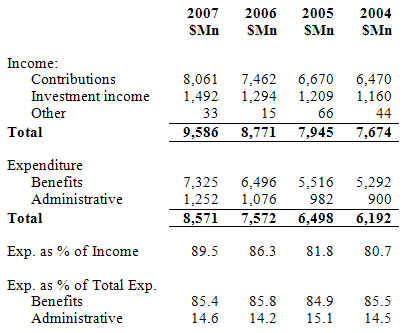
Some of the data seem inconsistent with the statistics provided by the Finance Minister in his 2008 Budget presentation, particularly as they relate to sectoral growth and labour participation. I will refer to some of those apparent inconsistencies later but now offer a review of the operating performance of the scheme for the year and compare it with the preceding three years.

20090426_table1
Source: NIS Annual Reports 2004-2007

Before discussing these numbers we need to be clear: Dr Roger Luncheon who has been Chairman of the Board since 1992 is incorrect in stating that the audited statements prove that the NIS is sound. The soundness of an entity, such as the NIS, that provides long-term benefits is determined, not by the auditors but by an actuarial examination which, using a range of data and assumptions, projects into the future. In fact the auditors draw specific attention to the report by the actuaries while the financial statements devote a full two pages to the recommendations of the actuary. Those, like the recommendations for the 2001 examination, are still being “reviewed” by the directors. Among the actuary’s many recommendations is the immediate need to address a shortfall of 7.1% in the contribution rate − hardly a sign of financial soundness. The problem for Dr Luncheon is that he seems unable to distinguish when he should speak as a politician, or as a director with fiduciary obligations or as a key policymaker responsible for oversight.

Commentary
Income over the period 2004 to 2007 has increased by 24.6% while expenditure has increased by 38.4%. Expressed another way expenditure as a percentage of income has moved within the short period of three years from 80.7% to 89.5%, a significant increase indeed. On the other hand, the composition of expenditure between Benefits and Administrative Costs has remained − as the Table shows − extremely constant. The significance and danger of the increase is best seen when compared with say the average of the five years 1997 to 2001 when it was below 60%. The warnings to the decision-makers about the growth of expenditure relative to income are not new and have been as consistently made as they have been consistently ignored.

With over 80% of its expenditure being in long-term benefits, the scheme should be concerned primarily about its actuarial viability which automatically takes care of its financial soundness, to use Dr Luncheon’s word. But to make up for the unwillingness of the government to raise the rates of contributions to levels that would meet actuarial sustainability, the scheme has become involved in investments that could seriously undermine both its actuarial and financial viability.

The 2006 Actuarial Report projected that total expenditure would, in 2014, exceed total income for the first time in the scheme’s forty years and unless contribution rates are increased the scheme’s reserves would be exhausted by 2022. With the (temporary?) loss of its capital and income in Clico investments and the inaction of the government and the board, including in addition to Dr Luncheon, PPP/C fixtures like trade unionist Komal Chand and Chitraykha Dass, it is possible that the actuary’s fears about expenditure exceeding income may happen sooner rather than later.

Blame the employers
Much of the problems of the Scheme are attributed to delinquent employers not paying over their contributions. As the logic goes the scheme would have been able to invest those monies and earn investment income. However there is nothing to indicate that investments are managed any better than contributions. According to Dr Luncheon the scheme’s investments are made based on a Prudential Investment Progamme which was “baptised by cabinet.” It is therefore surprising that the President recently criticized investments made under that programme when he is the head of the cabinet.

Dr Luncheon correctly states that the law governs the NIS and its investments (particularly those outside government paper) but does not recognise or acknowledge that the report and recommendations underlying that programme did not once mention the restrictions which the law places on the type of investments which the scheme can make.

There is increasing evidence that many of the scheme’s investments are not authorised by law and are not as profitable as they may appear. We will look more closely at the question of the investments under Balance Sheet but with respect to investment income, while $1.492B appears in the income statement, some $790M is shown as investment income receivable. The level was likely to be the same when Clico was put under judicial management and there is still uncertainty as to whether the government would cover accrued interest in its bailout of that entity. The possible infringement of the law, the high risks being undertaken in the search for high returns and the apparent delay in the receipt of investment income would cause even ordinary persons serious migraine. It is therefore very surprising that this does not seem to trouble the board which includes Messrs Maurice Solomon and Paul Cheong who have been on the board for several years and who would be fully aware of the concerns of the actuary about the viability of the scheme.

20090426_table1
Source: NIS Annual Reports 2004-2007

Included in Current Assets for 2007 is an amount of $197M as sundry receivables (2006-$207M) and prepayments of $62M (2006-$2M). Neither of these amounts is explained for the poor contributor, a key stakeholder. Included as well is an amount of $790M (2006-$753M) described as Accrued income, ie income recognised but not received. Nothing would be wrong with such accounting unless the entities in which the investments are made do not have the cash resources to pay the interest. Other than Treasury Bills the scheme’s principal investments are the Berbice Bridge Company Inc $1.560B; Clico $5.195B; Hand-in-Hand Trust Corp Inc $2.465B; a 25-year US$4M loan to the Government of Guyana for the construction of the Caricom Headquarters and Laparkan Holdings Limited $276M. From a concentration perspective, directly and indirectly the NIS is dangerously exposed with the Berbice Bridge.

With one exception (Laparkan), the private sector entities have recently been subject to public scrutiny − mostly negative – which can impact on their own profitability and their debt service capability. Clico is an immediate and major problem for the NIS. The Berbice Bridge can become another if its cash flows do not pick up significantly to allow it to meet its huge annual interest obligations. Hand-In-Hand Trust (HIHT) has just lost almost its entire reserves with its Stanford investment and as a consequence, a major income stream.

At more than $10B, NIS investments and accrued income in Clico, the Bridge and HIHT account for about 35% of the reserves of the scheme. A significant portion of the $10B is already impaired. The loss has implications not only for the balance sheet and therefore its reserves but annual income as well. It has been estimated that the income the NIS is losing on a daily basis on the Clico investment alone is more than $1M. When the actuary predicted the evaporation of the scheme’s reserves, he did not contemplate the kind of man-made, governance-created misfortunes we are now experiencing. Employees and employers better prepare for what can be a rough and costly ride.

Some statistics
2007 was the year of the World Cup, the biggest sporting extravaganza ever hosted by Guyana. According to Dr Singh there was 5.4% real growth in the economy with increased contributions by sugar (2.7%); mining and quarrying (22.7%); engineering and construction (5.7%) and transportation and communication (9%). Inflation grew by 14% and the minimum wage in the public sector grew by 14.5%. These significant numbers and impressive statistics however are not matched by growth in contribution income (8.01%) or registrations of employers by industry types (Table A of the report) which disclose that not a single sector had a new employer registrant with over 100 employees, and only three had between 51 and 100 employees. These were Transport, Community and Business Services and Personal Services, an interesting and eclectic mix indeed.

Women registrants in the Employed Persons category are fast catching up with their male counterparts and in 2007 for every 100 males there were 87 females. In the self-employed category the ratio is about 2:1. Compared with the gender mix of pensioners (more than 3 males for every 1 female) there is a dramatic transformation in the workforce, even as women still carry the burden of the work to be done at home. Only in the age group 41-45 do women come anywhere close to men in the number of self-employed registrants in 2007. Table G of the report indicates that some sixty-five persons in receipt of Old Age Pension are aged 98 and a surprising 389 are 95 years and older. With such numbers we should have far more centenarians than our newspapers consider worthy of celebration. We need to make sure that there are no phantom pensioners.

One other significant gender difference appears in Table N which presents the number of sickness spells by diagnosis and sector. Here women seem to do very badly. Diseases of the female genital organs accounted for 880 sickness spells, the fourth highest. Complications arising from pregnancy and childbirth account for 845 sickness spells, the fifth highest. Such statistics should impress both our Ministers of Health, and the Ministers of Labour and Human Services. While the statistics are not significantly different from preceding years it is yet hoped that we will see some policy initiatives to address them.

Conclusion
The state of the NIS confronts the government with a real dilemma. The government seems to have an insatiable appetite for spending which it finances mainly through direct taxes (Income and Corporation Tax) and indirect taxes (VAT, Excise and Customs) borne mainly by the workers and the lower income group. As a result Guyana is now among the most taxed countries in the world. In public finance, NIS contributions are a tax. Except that in a contributions-based scheme such as ours, the contributor can get back benefits in proportion to contributions. Even without the Clico debacle and the other challenges, contributions should have been increased. Based on the recommendations of the actuary the required contribution rate (without Clico) should be around 20% instead of 13% but the government’s reluctance to increase the rate may reflect its own recognition that increased NIS contributions are already too high for the overtaxed Guyanese.

While the NIS inherited by the government in 1992 was not as healthy as one would like, its condition is now much worse. The expenditure to income ratio was already 67% in 1992. It is now 89%. Failure by the government over the years to act promptly on successive actuarial recommendations has aggravated the situation. This however does not exonerate the directors of the NIS who have sat back and done precious little to stem the drift.