
On the Line: New Building Society Limited Annual Report 2008

– $200M exchange loss

Introduction
Forgive the rather misleading heading which is the standard for the review of annual reports in this column. It is misleading because at the time of writing the annual report of the Society, including the report of the directors and the financial statements, has not yet been made available to its members. Compelled by its own law that the AGM must be held before April 30, the directors have chosen for the venue of the meeting the Cotton Tree Primary School, West Coast, Berbice on Saturday April 25 with the first item on the agenda “to receive the financial statements and the Reports of the Directors for 2008.”
The financial statements of the Society audited by long serving and proposed-to-be-replaced Jack A Alli, Sons and Company show growth in deposits by just over 5% from $28.9B to $30.5B. This is the smallest percentage increase in deposits since 2002 and represents a recent trend of declining annual percentage increases. More significantly, however, is the decline of more than $103M in profits for the year. This is the second successive decline but is the highest decline recorded by the Society in recent history. Readers will recall that the 2007 profits were charged with the sum of $74M resulting from the fraud on an account holder.

It really has not been two good years for the Society under new Chairman Dr Nanda Gopaul, who signed the 2008 financial statements along with Mr Floyd McDonald, Deputy Chairman and former Commissioner of Police now on contract with the government, and Mr A Khan, Director/Secretary.

Commentary
The major reason for the decline in 2008 is an exchange loss of $200M, arising almost entirely on UK Government Treasury Bills which are denominated in pounds sterling, the exchange rate of which declined to the Guyana dollar by more than 20% between December 31, 2007 and December 31, 2008. While the Society had an exchange gain of $67M in 2007 it may be time for the directors to consider whether in the light of the volatility of international currencies it should liquidate those investments and repatriate the proceeds or invest in a currency to which the Guyana dollar is more aligned.

Loan assets have increased by 12.1 % from $16.99B to $19.1B almost a third more than GBTI, the performance of which was reviewed in a guest column last week and which has deposits of considerably more than the NBS. NBS, a creature of legislation, is restricted to how much it may lend and the nature of the security it has to have. On the other hand its income is tax-exempt and it can afford to and does pay the highest rates of interest on deposit accounts and charges the lowest rates on lending.

Despite the fall in income, reserves have increased from $4.5B to $4.79B or 6.4%. The Society is cash strong with some $4.2B in cash resources, almost all being held in interest-bearing fixed deposits. As discussed later in this column, that position would change significantly in 2009. The average interest earned on those resources was 5.6% compared with 4.2% earned in 2007. Investments which with the exception of the bridge bonds are liquid, amount to $11.3B, down from $13.55B. They earned an average return of 4.3% in 2008 compared with 4.5% in 2007.

Governance, the bridge and Clico
Perhaps the most controversial issue arising out of the financial statements is its investment in the Berbice Bridge. When financing for the bridge was first sought, the Society was approached by Mr Winston Brassington for a $3B investment. Independent consultant Raymond Gaskin questioned both the lawfulness and the viability of the investment and it is understood that on a split-decision the board, with Mr Moen McDoom as Chairman, accepted the advice and rejected the approach but went for $350M, a sum it was “prepared to lose.” Just over one year later the board with Dr Gopaul as Chairman reversed itself, and according to the financial statements bought bridge bonds with a face value of $1.5B. Regrettably the financial statements do not disclose the price paid for those bonds, but it is believed that they were bought at face value. More controversially, not only did the board reverse itself, but from all reports it did so by way of round-robin, ie without a physical meeting of the directors.

The composition of the board has changed significantly since its rejection of the $3B overture. Of the four who voted against the investment Mr McDoom has been replaced by Dr Nanda Gopaul, Director Secretary Mr Maurice Arjoon’s services have been terminated and directors Leon Rockliffe and Steve Bovell were voted off the board. As a result of the changes, the board with one exception is now made up of persons close to the government or the ruling party, some of whom are in receipt of compensation from the public purse. Mr Clement DeNobrega, a professionally qualified accountant who was elected as a director in April 2008 resigned some five months later, apparently dissatisfied with the way the board conducts the business of the Society. Once again there is no accountant on the board nor, as far as I am aware, is there any governance committee in the Society. Mr Kenneth Joseph, Head of NAACIE and the pro-government breakaway trade union organisation FITUG, was appointed by the board to fill the vacancy left by Mr DeNobrega’s resignation. His appointment is to be confirmed at the AGM.

Another possible reason for the reversal of the decision to invest in the Bonds may have to do with note 23 to the financial statements: Events After the Balance Sheet Date. This reports ambiguously that the Society’s retirement benefit plan held at December 31, 2008 a flexible annuity policy with Clico amounting to $110.9M. Note 12 to the financial statements devotes a full two pages to the plan, but did not refer to note 23. The directors should not by their silence encourage speculation that the Society may have undertaken the purchase of the bonds from Clico on the understanding that it could deduct the value of the policy from the purchase price of the bonds. That is a possibility fraught with serious legal implications and requires an unambiguous statement from the board which despite the public furore over the matter has so far not even publicly acknowledged the purchase.

Governance and risk
With the recent purchase significantly altering the composition of the Society’s assets and liquidity position, the Society is betting more than 40% of its accumulated profits on the Berbice Bridge Company meeting its annual interest obligations of about $800M. The financial projections were considered “overly optimistic” by the independent consultant. If the Bridge Company is unable to do so, then the Society could find itself along with other bondholders having to mark down the investment in its accounts. A proper analysis would have to wait on the release of financial statements of the Berbice Bridge Company.

The liquidity situation of the Society will be further eroded as it engages on the construction of a new, near billion-dollar head office in Georgetown. Consulting work in connection with that building is now the subject of a court action, but the investment itself is hardly the type of investment any risk-conscious entity would undertake in an uncertain financial environment.

Governance and the Bank of Guyana
One concern that has been vociferously expressed recently is the non-supervision of the Society by the financial regulator, the Bank of Guyana (BoG). The bank does not dispute that the Society carries on financial business as defined by the Financial Institutions Act which requires it to have a licence issued by the BoG. Yet it has inexplicably failed to enforce this provision. Such laxity by the regulator can have serious implications for any financial institution, let alone one that is subject to the control of persons with strong political affiliations and no private sector experience.

Without such a licence the Society does not operate within the FIA, which among other things provides for single borrowers limits to minimise the impact of a failure of a single loan or investment. Even if the Bridge Company investment was lawful, had the FIA applied to the Society then it would have been prevented from investing more than approximately $1.2B in the Bridge Company. The Society would also have been subject to the reserve requirement and its directors to the “fit and proper test.” It is hardly likely that such a loaded board could collectively be considered “fit and proper” to direct the operations of the third largest financial institution in the country.

Governance and members
The decision by the Society to hold its first ever meeting outside of Georgetown in 2008 followed a contentious meeting in September 2007 requisitioned by members who questioned the board about a fraud, the existence and implications of which it had stoutly denied. Those members were vindicated when the Society was left to make good the fraud to the tune of $73M. This time the dissatisfaction is about the adequacy and contents of the notice of Saturday’s meeting. By law, notice must be given 21 (clear) days prior to the meeting which does not appear to have been the case. Item 8 on the agenda seeks to increase the lending limit from $10M to $12M and beyond, even as the quality of the assets to secure lending has been diluted both by practice and the Berbice Bridge Company Act 2006. The implications are huge – higher lending and lower security will lead to higher provisioning and loan losses.

Governance and the auditors
By a notice in Friday’s newspapers the Society is proposing to replace long-serving auditors Jack A Alli, Sons & Co “in accordance with Rule No. 16 of the Act.” Apart from the statutory rules governing change of auditors there is also professional guidance under which any auditor proposed for nomination should seek professional clearance from the outgoing auditors. My understanding is that this has not been done. This could lead to an absurdity if it had to wait until after the meeting. In any case the outgoing auditors would be represented at the meeting to answer any questions, should these arise.

The proposed new auditors are Solomon, Parmessar & Co, headed by Mr Maurice Solomon, a director of the National Insurance Scheme. At a minimum this late change which appears to have taken the outgoing auditors by surprise must be regarded with considerable concern, since a change in auditors is done only for very good reasons.

Conclusion
Despite the mounting concerns the Bank of Guyana seems unwilling to act in a timely manner. It failed to do so with Globe Trust. It failed to act with Clico in connection with its deposit-taking. It should not fail the members of the Society. A group calling itself the Concerned Members of the NBS (including the writer) will be meeting Tuesday coming to decide on its participation at the AGM.

Recent developments involving Clico, the NIS, the NBS and Hand-in-Hand Trust show how contagion plays out in the financial and credit markets. The role of regulations is to prevent, detect and minimise such contagion. But effective regulations require as well independence and will. The NBS offers the Bank of Guyana another opportunity to show that it is on the ball.
It’s not too late for President to honour promise to Globe Trust depositors

The Kaieteur News of Thursday April 9, 2009 reported the Office of the President (OP) as stating that I and other (sic) directors of Globe Trust blocked payout of up to $100,000 each to 5,404 depositors of the financial institution. Apparently OP produced a “critique” to support its allegation that it was certain that up to “$235M would have been recovered from the realizable assets of Globe Trust”. I will deal briefly with the allegation, indicate my role in the Globe Trust imbroglio and offer a possible reason for President Jagdeo’s breach of promise.

The allegation though malicious and misleading is not surprising. It is also a mathematical impossibility. Even a junior clerk in the Office of the President could have told the manufacturer of the allegation that 5,404 times $100,000 is $540.4M. Where would the balance of $305.4 M ($540.4 M – $$235 M) have come from? But even the figure of $235 M is what the Liquidator very recently said was actually collected to date.

The architects of the allegation obviously intended to divert attention from my assertion – which I now repeat – that Jagdeo on August 3, 2001 had promised that approximately 2,000 small depositors defined by him as those with savings “in the vicinity of about $10,000 each” would get back their money. Instead of responding to my factual assertion, they create this absurd allegation and spurious diversion.

Second, I never was a director of Globe Trust or had a direct role in the Globe Trust case. Ram & McRae was retained by the institution to advise on and prepare a restructuring plan to address the difficulties being faced by the company. I was not a party to the action No 429/P in which Bank of Guyana (BoG) was the petitioner and Globe Trust was the respondent. I appeared as a witness to explain what came to be referred to as the Ram & McRae plan. I should add that the plan itself had identified as a first step – partly for administrative reasons – the repayment of all the under $10,000 accounts. In other words, there was no opposition to Jagdeo’s pledge which by coincidence was consistent with the Ram & McRae plan.

The basis of the intervention by Globe Trust in the legal action was that the BoG had acted outside of the law (the Financial Institutions Act) when on September 20, 2001 it took possession of Globe Trust “for the purpose of liquidation”. Then Chief Justice Carl Singh in his prompt, written judgment found that the decision by the BoG “manifested its misconception of its powers”; that the determination by the BoG that Globe Trust could not be restored to financial soundness was made “in a manner that was unfair to Globe Trust”; and that Globe Trust had been “unfairly treated”. The Chief Justice however did not hesitate to criticise the directors of Globe Trust for their “failure to act decisively in the face of lax, loose and grossly incompetent management.”

I should add that as set out in the written submission of Attorney-at-Law Stephen Fraser for Globe Trust, its intervention and proposed restructuring plan was not an objection to the Bank of Guyana assuming possession. In fact the point was made by Globe Trust director Professor Clive Thomas and emphasised by Mr. Fraser that the foundation of the Ram & McRae plan was that it would operate under the protection of the Financial Institutions Act. The premature and high-handed manner in which the Bank of Guyana acted leads inescapably to the conclusion that it did not want Globe Trust to survive.

Regarding the President’s failure to honour his commitment, it is possible that he forgot, which is human. But my belief is that when he made his promise on August 3, 2001 he hoped to neutralise popular opposition to an unlawful and politics-driven decision that had already been made but not yet announced – to liquidate Globe Trust. The liquidation announcement came seven weeks later. In the end he got both his wishes, i.e. the liquidation of Globe Trust and preempting any opposition. No need then to bother about any commitment.

A final thought. For years I have tried unsuccessfully to get the President not to make unlawful and unconstitutional spending out of the Lotto funds and more recently out of the Privatisation proceeds. Now OP would have the public believe that I prevented the President from meeting an obligation he made in good faith. Like their math, this just does not add up.

But it is still not too late. The President’s guarantee on Clico involving failures by his people is the equivalent of a blank cheque for billions and billions. He knows the exact and comparatively modest exposure on Globe Trust. It is far easier and clearly less costly for him to honour that commitment. I am not in his way.

On the line: Guyana Bank for Trade and Industry Annual Report 2008

Guest business column by Robert V McRae, CPA

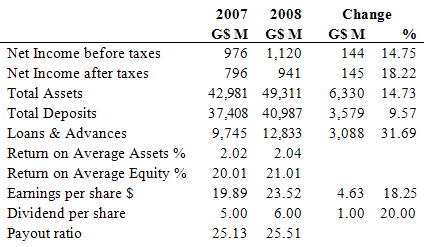
Come Tuesday afternoon the Guyana Bank for Trade and Industry (GBTI) will be holding its 21st Annual General Meeting at the Pegasus Hotel, a stone’s throw from where it is constructing a new multi-storey head office. The results of the bank for the year continue a trend of excellent performance by the banking sector during 2008 with GBTI’s profit before tax topping the billion dollar mark, increasing by 14% to $1.1B and profit after tax by 18% to $941M. The satisfaction in the results is reflected in the glowing reports by the Chairman Mr Robin Stoby SC, and Mr RK Sharma, CEO, as well as in the self-congratulatory Statement on Corporate Governance about the technical competence, time, communications skill and integrity of the directors.

The Annual Report is once again well laid out with lots of pictures, charts and tables, although unfortunately some of the charts are unlabelled or the descriptions are incomplete; in one case the text has been partially over-written by a photograph while an important paragraph was cut midway in the Chairman’s report.

In his report for the year Chairman Stoby wrote about the second half of 2008 in the future tense while Chief Executive Officer Mr Sharma offers banking statistics that are several months out of date. Up-to-date information would have been so much more relevant and meaningful.

Highlights
Highlights

As Chairman Stoby points out the dividend of $6 per share proposed by the directors is the highest in the bank’s history. Yet this represents a mere 25.51% of the year’s distributable profits compared with 25.13% in 2007. Earnings per share grew by 18.25% over 2007 and a whopping 256.9% over 2004. With the company’s shares trading at $130, the P/E ratio, a popular investment measure, is an attractive 5.5. With increased profits, other measures such as Return on Average Assets and Average Equity have also improved over the year and the past four years.

Measured in terms of share price at the beginning of the year, shareholders receive a return of 41.7% in dividends and capital appreciation, while depositors of interest bearing accounts earned 3.5% (same as 2007) and the average interest earned by all depositors remained constant at 2.6%. With official inflation for 2008 running at 6.4%, the purchasing power of depositors’ funds was actually less than at the beginning of the year.

The interest earned on average loans held declined from 12.4% and 11.7% (15.1% to 13.4% if calculated on balance sheet values) and because the rate of interest paid remained constant, net interest cover declined slightly from 1.75 to 1.65. Once again a major source of income is Foreign Exchange Trading Gains which amounted to $663M or 25% of interest income, up slightly over the previous year. With an increasing share of its assets invested abroad interest earned on foreign bank deposits was $412M, up from $336M in 2007.

Distribution of assets
Of the total of $49.3B of assets, cash and cash resources accounted for 52%; loans and advances 26%; investments 12%; and the remaining 10% held in the form of fixed and other assets. The major borrowing sectors were trade and distribution (41%); agriculture (21%); household (15%); manufacturing (17%); and mining and quarrying (6%). The bias in the lending portfolio reflects the bank’s lending strategy based, as it states, on Quality Lifestyle and Commercial Loans. In fact the lending to the agriculture sector would have been less than half had it not been for a $1.8B facility from the European Union to improve the rice sector. In 2007, agriculture accounted for a mere 7.6% of the bank’s loan portfolio, down from the 9% in 2006.

Cash resources ($12B) are made up principally of deposits with other banks and investments ($11.5B). For what appears to be tax reasons, the cash resources are invested almost entirely outside of Guyana while the investments are mainly in Government of Guyana Treasury Bills.

The logic that dictates that insurance companies invest the bulk of their funds in Guyana while commercial banks are free to do otherwise should interest the country’s policymakers having regard to the new Caricom Single Market and Economy rules.

Effective tax rate
Two years ago the bank’s effective corporation tax rate was 33.1% but this fell to 16.6% in 2007. It has now fallen further to 13.6% in 2008. The reader would be forgiven for being surprised by the disparity between the nominal corporation tax rate of 45% and the 13% rate paid by the bank. The explanation lies in the opportunities offered by the tax laws, including the Caricom Double Taxation Treaty, to exclude from or significantly reduce the rate of tax on certain income. That treaty provides that the interest earned in any of the Caricom states by a resident of Guyana is exempt from tax in Guyana. The interest income which can be earned in the region ranges from zero per cent to no more than 20% so that the treaty made in 1994 and reinforced by the Revised Treaty of Chaguaramas actually rewards banks for taking Guyanese depositors’ funds and investing them overseas.

If Guyana would pay any interest to tax policy it would see how dysfunctional our tax system is. Not only does it reward such practices but adds to them by allowing additional types of interest earned by banks to be exempt from taxation − low income housing and rescheduled debts being the more common examples. Yet the law allows, without limitation, all the expenses incurred in earning tax-free interest to be deductible against the remaining taxable income.

In addition, dividends are tax-free because of a popular assumption that the income out of which dividends are paid has already been taxed. Not only does such a misconception ignore the fundamental concept of source to taxation, but GBTI is one example of the extent to which practice can vitiate logic. Even if we assume that the company is a proxy for the shareholder then the shareholders of the bank would be enjoying an effective tax rate of 13% in 2008 while employees are taxed at 33.33% and a further 5.2% (subject to a ceiling) for NIS, and depositors pay a final withholding tax of 20% on interest earned. Unfortunately this and similar information are entirely missing from the sporadic debate on tax reform which is often shallow and easily dismissed by the government.

Governance
During 2007 the company appointed two new directors, Messrs Michael Cummings and Carlton James, about whom nothing is stated in the Annual Report, bringing the total to ten. The full-page Statement on Corporate Governance speaks of the bank’s sound exercise of corporate governance and identifies only a single committee considered necessary for this. This is the Audit Committee about whose operation during the year little is said. Of a board of ten there are only two executive directors, but only five of the directors are independent. In the case of the Chairman, his law firm is retained to do a range of legal work for the bank and its customers. It is time for this approach to legal work to be discontinued and borrowers be allowed to retain counsel of their choice using standard forms agreed by lenders and the legal profession.

The blog and the BoG
In late February a post on a blog alleged that the bank had applied for a billion-dollar bail-out. The Bank of Guyana reacted swiftly and “categorically denied” that it had been approached by the GBTI for liquidity support. In fact, the Annual Report states at page 55 that GBTI had overnight borrowing of $1.5B from the Bank of Guyana. Surely this could not have been done without an approach and makes the categorical denial by the BoG at best misleading.

In addition, the report shows that GBTI failed to meet its reserve requirement with the Bank of Guyana at consecutive year ends. A shortfall (described as a negative excess in the accounts) of $2.431B at 31.12.07 increased to over $4.078B at 31.12.08. This is a clear breach of the law, represents an unauthorised advance to GBTI by the BoG, is probably interest free and of course constitutes unfair competition. The reserve requirement is a form of insurance for depositors and its “negative excess” constitutes an arbitrary and unauthorised reduction by the bank which the BoG should not tolerate. It should have long instructed the bank to come into line, enforcing such penalties and interest as appropriate.

Clico, the NBS and NIS

Introduction
Clico is by far the worst financial disaster ever to have hit Guyana. For hundreds of thousands of Guyanese the Clico saga is direct, personal and painful, a real life disaster in which many could be made paupers. And even if that calamity is averted, the so-called guarantee that the people and the opposition have been calling for will have two effects. First, the taxpayers will be worse off by several billions of dollars. And second, having demanded heads for the Clico fiasco, the opposition members of the National Assembly will give the government a crucial let-off. When it did have the opportunity, instead of mounting an investigation into Clico and related matters, the National Assembly simply asked the Economics Affairs Committee to monitor the Clico affair.

Clico in combination with Stanford is the public face of unprecedented fraud in the securities sense of the word, practically non-existent corporate governance, outrageously bad regulatory failures, an arrogant display of political ineptitude, and inexcusable conflicts of interest and duty in various manifestations. The two are our Enron, Madoff and Satyam wrapped in one. They are the stuff of which bestsellers are made; of heroes and villains exchanging roles and of juicy material for the economic historians. They offer the potential for the most intriguing legal cases of breach of fiduciary obligation, fraud, lifting the veil of incorporation in the private sector and misfeasance in the public sector.

Winding up Clico
Despite the urgency of the matter, the Economic Affairs Committee of the National Assembly has done nothing so far. The Judicial Manager of Clico, Ms Maria van Beek is supporting the retention of (former?) Clico CEO Ms Geeta Singh-Knight who up to recently Ms van Beek was saying had persistently breached the Insurance Act. Ms van Beek must be aware that in her other role as Commissioner of Insurance she has a continuing duty to prosecute those involved in such breaches and that her endorsement of the retention of Ms Singh-Knight could be construed as granting her immunity. When Ms van Beek first approached the court she asked, as an alternative to her first choice of winding-up, to be appointed as Judicial Manager. Now she seems unclear of the nature and extent of the duties involved. Even if the Insurance Act is unclear, she should be guided by commonsense, experience, professional advice and as necessary, by the court. Logic dictates that the closest analogy to the Judicial Manager is the Receiver Manager under the Companies Act. That person displaces the management and takes control of the company. What is wrong with that formulation?

Having asked the court for a winding-up order the Judicial Manager seems bent on vindicating her initial judgment. Neither she nor the government has shown any interest in saving Clico. If they wanted to save Clico and jobs then Trinidad provided a most recent and eminently sensible model – take over the company and use the very funds of the Jagdeo guarantee as capital injection. But because of the ambivalence and dithering of the government and the Judicial Manager, Clico is collapsing faster than anyone could have predicted.

Breach of promise
And perhaps there should be a mild reminder that President Jagdeo promised that small depositors in Globe Trust would be protected. Several years later, not a single, blind cent has been paid, despite the finding of the then Chief Justice that the regulator was partly responsible. In the case of Clico, President Jagdeo again has made promises but when it comes to confirming that promise, his party in the National Assembly is silent. They and the President know that the public has become accustomed to broken promises.

Mr Jagdeo has said that Clico is insignificant in the wider scheme of things – only 3%! But does the President realize that the Clico/Stanford duo now pose a risk to the New Building Society (NBS), the National Insurance Scheme (NIS), Hand-in-Hand Trust, Trust Company Guyana Limited and undisclosed pension schemes over several sectors? Mr Jagdeo claims to be guaranteeing the Clico clients but what about the pension schemes – are their members any less important?

Milking the NBS cow
Carefully built up some sixty years ago out of the ashes of its failed predecessor, the NBS through conservative and tight-fisted management under the late Jules De Cambra, was one of the strongest financial institutions in the country. Under Moen McDoom and Nanda Gopaul, that soundness has been slipping away. It is history that the NBS was cajoled into investing in the Berbice Bridge. Its own independent consultant said it was a bad idea, that the assumptions underlying the financial projections were way too optimistic. Some members of the board were scared but not wishing to upset the government opted for a considerably smaller investment − an amount that the NBS could afford to lose. Next the board decided to spend several hundreds of millions of dollars on a state-of-the-art head office, causing two of its directors to resign in protest. Now, as Clico started to sink, the NBS again featured as a lifeline and the politicians went to work – turning up the heat and milking the NBS cow.

My understanding is that the Board of the NBS, which does not have any financial specialist and did not even meet in person to decide on buying Clico’s bonds in the bridge for $1.5B. However that decision may have been made, Dr Gopaul and his fellow directors have a duty to justify their decision to the members of the NBS. So far, the bridge is generating far less than Mr Jagdeo had predicted. It did not meet its 2008 interest obligations in their entirety. While the bridge company enjoys the most generous package of tax concessions imaginable, it will struggle to meet its obligations to pay interest or redeem the bonds as they fall due. To add to the risks, there is explicitly no government guarantee.

Despite the slippages, the government and the Bank of Guyana seem very comfortable with NBS remaining completely unregulated. The soundness of the NBS which this column has consistently praised has been undermined by the decisions and practices of the board and its bridge investment. That investment which had to be sanctioned by the Minister of Finance became possible when government did an underhand amendment to the NBS Act, through the Berbice Bridge Act. The NBS’s investment in the bridge now amounts to 40% of its reserves – an over concentration in a single company. No doubt we will hear from the President that we should not worry, that such investment represents only a small percentage of the assets of the financial sector. That is what the government said about Clico and the Bank of Guyana repeated in relation to the Hand-in-Hand Trust.

As political players gain the ascendancy at the bank it is becoming increasingly subservient to the Ministry of Finance, its role diminished to collecting statistics and undertaking bank inspections. It is abandoning − or doing very badly − one of its most important roles, the oversight of the financial sector.

Milking the NIS
The other institution under severe stress from Clico and the bridge is the NIS. Again we see the overlapping roles of the Minister of Finance, other government politicians and public and private sector functionaries at various levels, but connected in one way or the other to the Office of the President. One of the members of the NIS Board is also a director of the Berbice Bridge Inc. Two leading companies have used NIS funds to invest in the Berbice Bridge and have been rewarded with seats on the board of the Bridge Company − the same company in which Mr Winston Brassington confidently guaranteed “investors” in the bridge that the “NIS will not have a director” or be able “to exercise any influence” (Business Page March 12, 2006).

Several weeks ago, I wrote the Minister of Finance about the legality of the NIS investments, having in mind the bridge, Clico and the Hand-in-Hand Insurance Company. Investments made by the NIS are required to be approved by the Co-operative Finance Administration of which the Chairman is the Minister of Finance and who appoints all its directors. He has not responded to me. The board, it seems, is operating under an Investment Framework prepared by Mr Patrick van Beek. That framework had no reference to the restrictions imposed by the act but was accepted by cabinet. If it turns out that the investments are unlawful surely there are many who should be held responsible including the entire board of the NIS.

The NIS directly and indirectly is the largest investor in the Berbice Bridge which the government likes to boast is a private sector initiative. The manner in which Mr Brassington cajoled the NIS into investing in the bridge is a matter of public record, and the country’s collective failure to take note then is coming back to haunt us. Of course this is not the first time that the government is undermining the NIS’s finances. We recall that the government forced the NIS to lend it US$4M for the part-financing of the construction of the Caricom Secretariat. That loan is repayable over 25 years at a rate of 4% in the first 15 years and 5% in the next ten years. Those rates are well below the rates of inflation, but does the government care how the cow is milked?

Conclusion
The cost of the Clico failure is mounting, but with ‘Clico fatigue’ already setting in public interest may wane. For the NIS and NBS the implications are huge. The Minister of Finance, the government, the regulators and the directors of the NBS would be the beneficiaries of ‘Clico fatigue.’ The misuse of the NIS funds which began with small sums now involves billions. The risky investments of the NBS have likewise increased from millions to billions. The public has to show more interest while the opposition parties need to be more consistent and persistent.

Will we ever get to the bottom of the Clico saga? Unlikely. The PNCR, which endorsed the assurances given by the government on a Clico bailout, is now calling for an “urgent and impartial” inquiry. Aware that any inquiry will only confirm their massive failures and deception of the public, the government will stoutly resist such an inquiry. As far as the Finance Minister is concerned he has outmanoeuvred the opposition by his 16-page rambling in the National Assembly. The actions (or inactions) of the government and Clico’s Judicial Manager suggest that Clico will soon be dead and gone. All it will leave to its Children of Guyana are massive debts.

Information which was challenged in column came from Insurance Commissioner’s office

The tone of the March 3 letter of Commissioner of Insurance Maria Van Beek seems to suggest that she is reacting to the pressure from several quarters over her supervision of Clico. To accuse sections of the victims of the worst insurance failure in the country under her watch of making “reckless, uninformed and irresponsible pronouncements” (GINA release published March 1) might seem to indicate that Ms Van Beek is reluctant to acknowledge the scale of the problem or the extent of public concerns about potential personal and national losses of billions of dollars. Even if the government gives a complete bailout of Clico it is we the taxpayers who will pay it, while those who contributed to the crisis lecture us on how much they have done to protect us.

A number of persons have suggested to me that I should respond to the three issues she challenged me on: 1) the statutory fund/assets; 2) her reason for the approach to the court for a winding up of Clico; and 3) the name of the company, Clico.

1. I never claim to be an expert on insurance, accounting or indeed on any subject. However Ms Van Beek can rest assured that the provisions of the Insurance Act, including the difference between statutory assets and the statutory fund, would not escape any practising accountant. It is Ms Van Beek who has some explaining to do for apparently missing the assertion in Clico’s 2007 financial statements that the company had a “statutory fund” of $46 million and not the $9B she says it should be! As the expert and regulator of the sector, Ms Van Beek should tell the public what steps she took to have such an error in the audited financial statements rectified in a timely manner.

2. Ms Van Beek claims that I accused her of saying that it was Clico’s business model and investment strategy from which its problem stemmed. I did not invent that. Ms Van Beek said so in paragraph 10 of her affidavit. Ms Van Beek has insisted that it was the decision by The Bahamas authority to liquidate their Clico that triggered her move to the courts. It is not that decision which imperilled Clico Guyana’s investments.

Those unlawful and injudicious investments were impaired long before the move by The Bahamas authorities and required action, not excuse. But no, she waited until the property market in the US had collapsed taking with it huge amounts of Clico’s funds and then waited even further and longer on the Bahamian authorities.

3. Ms Van Beek writes that I wrote from an uninformed position concerning the name of the company. In her very affidavit she also refers to the company as SA!

In other words, everything Ms Van Beek accuses me of came out of her office.

Finally let me say that I welcome the press statement made by Ms Van Beek on the state of the company and note that she has taken several of the steps I advocated some weeks ago, including calling in the debts and guarantees of the related parties and giving specific advice to policyholders about the state of their insurance coverage. However she continues to repeat the vague promise she “attributes” to President Jagdeo that “no policyholder in Clico (Guyana) will lose their money.”

By now she should have sought written confirmation from the Minister of Finance to whom she reports, and not the President, of the precise nature and scope of the guarantee which in my view has to have parliamentary approval. Perhaps Stabroek News can clarify their report that Ms Van Beek “re-emphasised the assurances given by President Bharrat Jagdeo and Finance Minister Dr Ashni Singh, that no one with investments in the company will lose their money.” That goes well beyond policyholders and was not contained in the statement issued to the press. It would however naturally raise the hopes of investors including the NIS. It would be painful if that assurance turns out to be false.